

God’s generosity toward someone else is not an injustice toward you.
Some arrive at sunrise. Others arrive at five. Grace welcomes both.
God never gave you sheep so you could feed yourself.
God gave you sheep so you could feed them.
God’s answer to failed shepherds was to send the Good Shepherd.
God notices every person forgotten by powerful people.
When earthly shepherds fail, the Divine Shepherd starts searching.
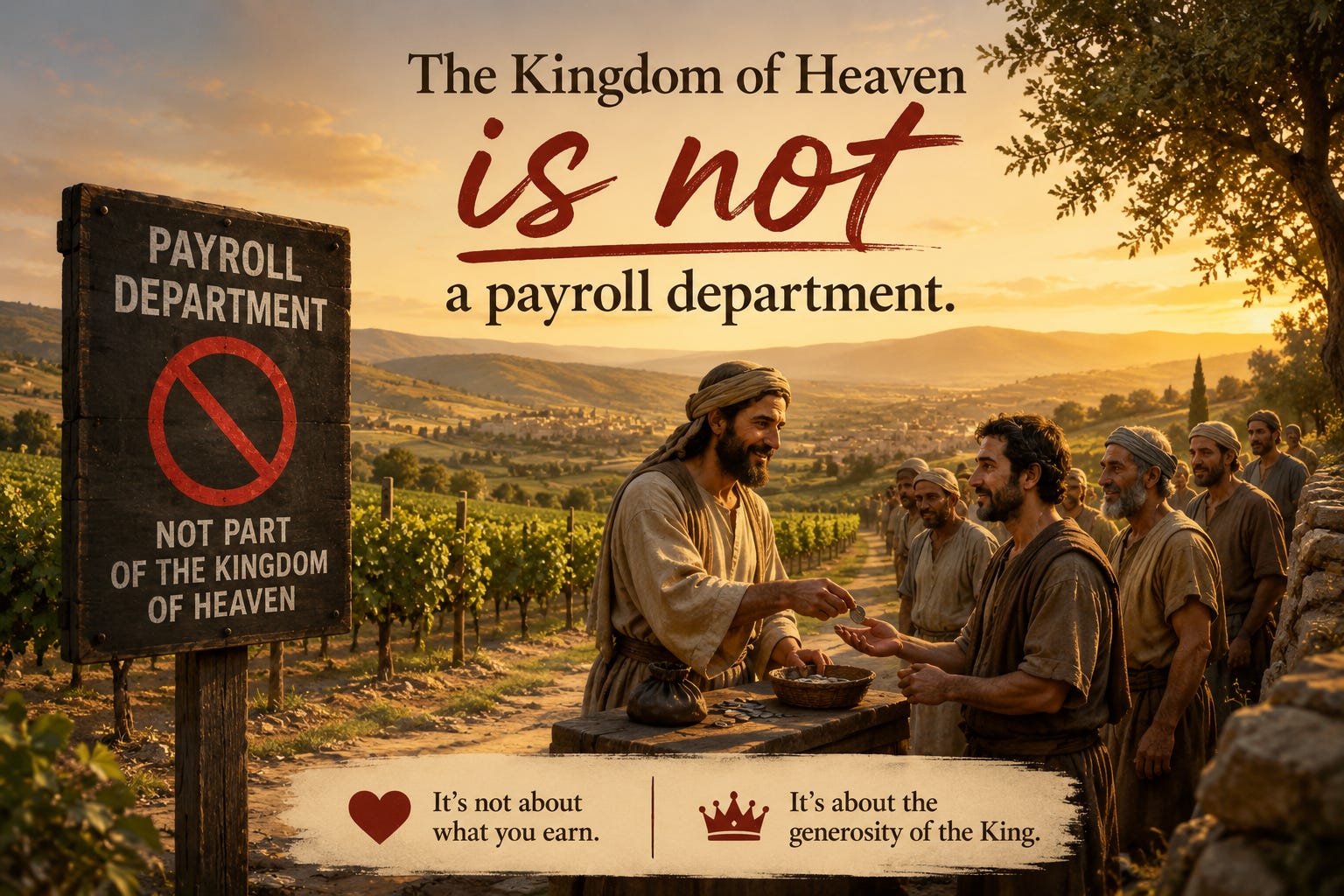
1st Reading:
(Ezekiel 34:1-11) The Lord spoke to me. “Mortal man,” he said, “denounce the rulers of Israel. Prophesy to them, and tell them what I, the Sovereign Lord, say to them: You are doomed, you shepherds of Israel! You take care of yourselves, but never tend the sheep. You drink the milk, and kill the eat the finest sheep. But you never tend to sheep. You have not taken care of the weak ones, healed the ones that are sick, bandaged the ones that are hurt, brought back the ones that wandered off, or looked for the ones that were lost. Instead, you treated them cruelly. Because the sheep had no shepherd, they were scattered, and wild animals killed and ate them. So my sheep wandered over the high hills and the mountains. They were scattered over the face of the earth, and no one looked for them or tired to find them.”
“Now, you shepherds, listen to what I, the Lord, am telling you. As surely as I am the living God, you had better listen to me. My sheep have been attacked by wild animals that killed and ate them because there was no shepherd. My shepherds did not try to find the sheep. They were taking care of themselves and not the sheep. So listen to me, you shepherds. I, the Sovereign Lord, declare that I am your enemy. I will take my sheep away from you and never again let you be their shepherds; never again will I let you take care only of yourselves. I will rescue my sheep from you and not let you eat them.”
“I, the Sovereign Lord, tell you that I myself will look for my sheep and take care of them.”
Through these verses, we learn:
(1) Leadership is a sacred responsibility, not an opportunity for self-enrichment
(2) Neglected sheep eventually becomes scattered sheep
(3) When human shepherds fail, God Himself searches for His sheep
Let’s consider each of these points:
(1) Leadership is a sacred responsibility, not an opportunity for self-enrichment:
The Lord spoke to me. “Mortal man,” he said, “denounce the rulers of Israel. Prophesy to them, and tell them what I, the Sovereign Lord, say to them: You are doomed, you shepherds of Israel! You take care of yourselves, but never tend the sheep. (v. 34:1-2)
God commands Ezekiel to prophesy directly against Israel’s shepherds
this command shows us that leaders are accountable to God
their failure: they have been feeding themselves rather than feeding the flock
You drink the milk, and kill the eat the finest sheep. But you never tend to sheep. (v. 34:3)
the leaders enjoy the benefits produced by the flock — milk and meat
while neglecting those who produced those benefits
God exposes a dangerous distortion of leadership
the people exist for the leaders instead of the leaders serving the people

You have not taken care of the weak ones, healed the ones that are sick, bandaged the ones that are hurt, brought back the ones that wandered off, or looked for the ones that were lost. Instead, you treated them cruelly. (v. 34:4)
God’s judgment begins with a searching question — what have you done with what the people have entrusted you with?
the shepherds cannot hide their conduct from God
authority never removes accountability
the greater the responsibility entrusted to you, the greater our obligation to serve rather than exploit
(2) Neglected sheep eventually becomes scattered sheep:
You have not taken care of the weak ones, healed the ones that are sick, bandaged the ones that are hurt, brought back the ones that wandered off, or looked for the ones that were lost. Instead, you treated them cruelly. (v. 34:4)
the weak were not strengthened
the sick were not healed and the injured were not bound up
those who wandered away were not brought back
those who became lost were not searched for — instead, the shepherds ruled them harshly and brutally
Because the sheep had no shepherd, they were scattered, and wild animals killed and ate them. So my sheep wandered over the high hills and the mountains. They were scattered over the face of the earth, and no one looked for them or tired to find them.” (v. 34:5-6)
without faithful shepherds — the sheep scattered and became vulnerable to predators
there is an important spiritual principle here — people do not always wander because they reject God — sometimes they wander because those entrusted with caring for them failed them
(3) When human shepherds fail, God Himself searches for His sheep:
“Now, you shepherds, listen to what I, the Lord, am telling you. As surely as I am the living God, you had better listen to me. My sheep have been attacked by wild animals that killed and ate them because there was no shepherd. My shepherds did not try to find the sheep. They were taking care of themselves and not the sheep. So listen to me, you shepherds. I, the Sovereign Lord, declare that I am your enemy. I will take my sheep away from you and never again let you be their shepherds; never again will I let you take care only of yourselves. I will rescue my sheep from you and not let you eat them.” (v. 34:7-10)
God declares that He is against the shepherds who have failed His flock
God will hold them accountable and remove the flock from their control
God will rescue His sheep so that they can no longer be exploited

“I, the Sovereign Lord, tell you that I myself will look for my sheep and take care of them.” (v. 34:11)
God then makes an extraordinary promise — “I will rescue my sheep from you and not let you eat them.”
the passage therefore moves from failed human shepherds to the divine Shepherd — a theme that ultimately points us toward Jesus — who comes searching for God’s scattered people
Ezekiel teaches us two things:
(1) God holds leaders accountable when they use people rather than serve them
(2) when earthly shepherds fail — God does not abandon His scattered sheep — God comes looking for them Himself
Fulfilling what was said:
(1) Theme: God Himself would shepherd His people:
Prophesy: (Ezekiel 34:11-16) The LORD God proclaims: I myself will search for my flock and seek them out. As a shepherd seeks out the flock when some in the flock have been scattered, so will I seek out my flock. I will rescue them from all the places where they were scattered during the time of clouds and thick darkness. I will gather and lead them out from the countries and peoples, and I will bring them to their own fertile land. I will feed them on Israel’s highlands, along the riverbeds, and in all the inhabited places. I will feed them in good pasture, and their sheepfold will be there, on Israel’s lofty highlands. On Israel’s highlands, they will lie down in a secure fold and feed on green pastures. I myself will feed my flock and make them lie down. This is what the LORD God says. I will seek out the lost, bring back the strays, bind up the wounded, and strengthen the weak. But the fat and the strong I will destroy, because I will tend my sheep with justice.
Fulfillment: (John 10:11) “I am the good shepherd. The good shepherd lays down his life for the sheep.”
God promises personally to search for His scattered sheep. Jesus deliberately assumes this identity.
(2) Theme: God would raise up one Davidic Shepherd:
Prophesy: (Psalm 23:1-3) David said, “The LORD is my shepherd. I lack nothing. He lets me rest in grassy meadows; he leads me to restful waters; he keeps me alive. He guides me in proper paths for the sake of his good name.”
Prophesy: (Jeremiah 23:5-6) The time is coming, declares the LORD, when I will raise up a righteous descendant from David’s line, and he will rule as a wise king. He will do what is just and right in the land. During his lifetime, Judah will be saved and Israel will live in safety. And his name will be The LORD Is Our Righteousness.
Fulfillment: (John 10:11) “I am the good shepherd. The good shepherd lays down his life for the sheep.”
God promises one shepherd, His servant David, over the flock. Since historical David has already died, this points toward the Davidic Messiah — Jesus Christ. Jesus has already come and this points forward to the 2nd Davidic Messiah.
(3) The Shepherd would gather God’s scattered people:
Prophesy: (Jeremiah 23:1-6) Watch out, you shepherds who destroy and scatter the sheep of my pasture, declares the LORD. This is what the LORD, the God of Israel, proclaims about the shepherds who “tend to” my people: You are the ones who have scattered my flock and driven them away. You haven’t attended to their needs, so I will take revenge on you for the terrible things you have done to them, declares the LORD. I myself will gather the few remaining sheep from all the countries where I have driven them. I will bring them back to their pasture, and they will be fruitful and multiply. I will place over them shepherds who care for them. Then they will no longer be afraid or dread harm, nor will any be missing, declares the LORD.
Fulfillment: (John 10:11) “I am the good shepherd. The good shepherd lays down his life for the sheep.”
Jeremiah condemns corrupt shepherds and promises a righteous Branch from David. Jesus comes as both Davidic King and Shepherd, gathering God’s people into one flock. The 2nd Davidic Messiah comes as the Right Branch of David.
How can we apply what we learned — to how we live today?
we are reminded that leadership — whether in government, the Church, business, family or community — is a stewardship rather than an ownership
we should ask whether our decisions strengthen the weak, help the wounded and seek those who have become isolated
leadership also challenges us not to dismiss people who have wandered away
the question may not simply be — Why did they leave? — but also — Did anyone go looking for them?
when human institutions or leaders disappoint us, our faith ultimately rests not in the shepherd but in the God who owns the flock
2nd Reading:
(Matthew 20:1-16) “The Kingdom of heaven is like this. Once there was a man who went out early in the morning to hire some men to work in his vineyard. He agreed to pay them the regular wage, a silver coin a day, and sent them to work in his vineyard. He went out again to the marketplace at nine o’clock and saw some men standing there doing nothing, so he told them, ‘You also go and work in the vineyard, and I will pay you a fair wage.’ So they went. Then at twelve o’clock and again at three o’clock he did the same thing. It was nearly five o’clock when he went to the marketplace and saw some other men still standing there. ‘Why are you wasting the whole day here doing nothing?’ he asked them. ‘No one hired us,’ they answered. ‘Well, then, you go and work in the vineyard,’ he told them.”
“When evening came, the owner told his foreman, ‘Call the workers and pay them their wages, starting with those who were hired last and ending with those who were hired first.’ The men who had begun to work at five o’clock were paid a silver coin each. So when the men who were the first to be hired came to be paid, they thought they would get more; but they too were given a silver coin each. They took their money and started grumbling against the employer. ‘These men who were hired last worked only one hour,’ they said, ‘while we put up with a whole day’s work in the hot sun — yet you paid them the same as you paid us!’ ‘Listen, friend,’ the owner answered one of them. ‘I have not cheated you. After all, you agreed to do a day’s work for one silver coin. Now take your pay and go home. I want to give this man who was hired last as much as I gave you. Don’t I have the right to do as I wish with my own money? Or are you jealous because I am generous?’”
And Jesus concluded, “So those who are last will be first, and those who are first will be last.”
Through these verses, we learn:
(1) God continually goes looking for people to enter His vineyard
(2) God’s grace cannot be reduced to an hourly wage
(3) Comparison can make another person’s blessing feel like our injustice
Let’s consider each of these points:
(1) God continually goes looking for people to enter His vineyard:
“The Kingdom of heaven is like this. Once there was a man who went out early in the morning to hire some men to work in his vineyard. (v. 19:1)
Jesus compares the Kingdom of heaven to a landowner who goes out early looking for workers
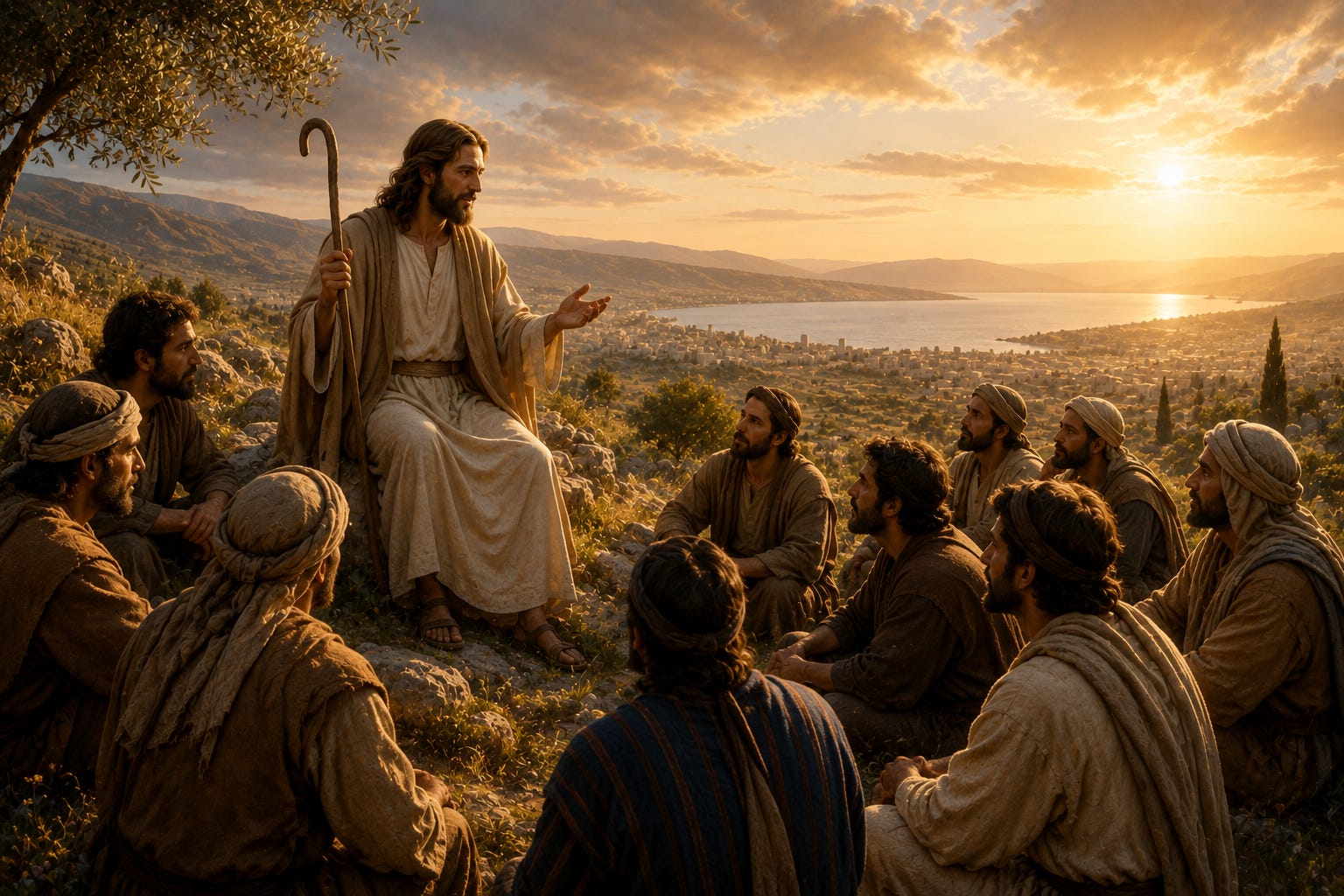
He agreed to pay them the regular wage, a silver coin a day, and sent them to work in his vineyard. (v. 19:2)
the first workers agree to the normal daily wage and enter the vineyard
He went out again to the marketplace at nine o’clock and saw some men standing there doing nothing, so he told them, ‘You also go and work in the vineyard, and I will pay you a fair wage.’ So they went. Then at twelve o’clock and again at three o’clock he did the same thing. (v.19:3-5)
the landowner returns around nine, noon and three — continually inviting additional workers into the vineyard
It was nearly five o’clock when he went to the marketplace and saw some other men still standing there. ‘Why are you wasting the whole day here doing nothing?’ he asked them. (v. 19:6)
astonishingly, the owner returns again around five — when the working day is almost over
‘No one hired us,’ they answered. ‘Well, then, you go and work in the vineyard,’ he told them.” (v. 19:7)
even those who have spent most of the day waiting are invited — ‘you go and work in the vineyard’
God therefore does not stop calling simply because the day is getting late
(2) God’s grace cannot be reduced to an hourly wage:
“When evening came, the owner told his foreman, ‘Call the workers and pay them their wages, starting with those who were hired last and ending with those who were hired first.’ (v. 20:8)
in the evening — the landowner orders the workers to be paid
beginning with those hired last
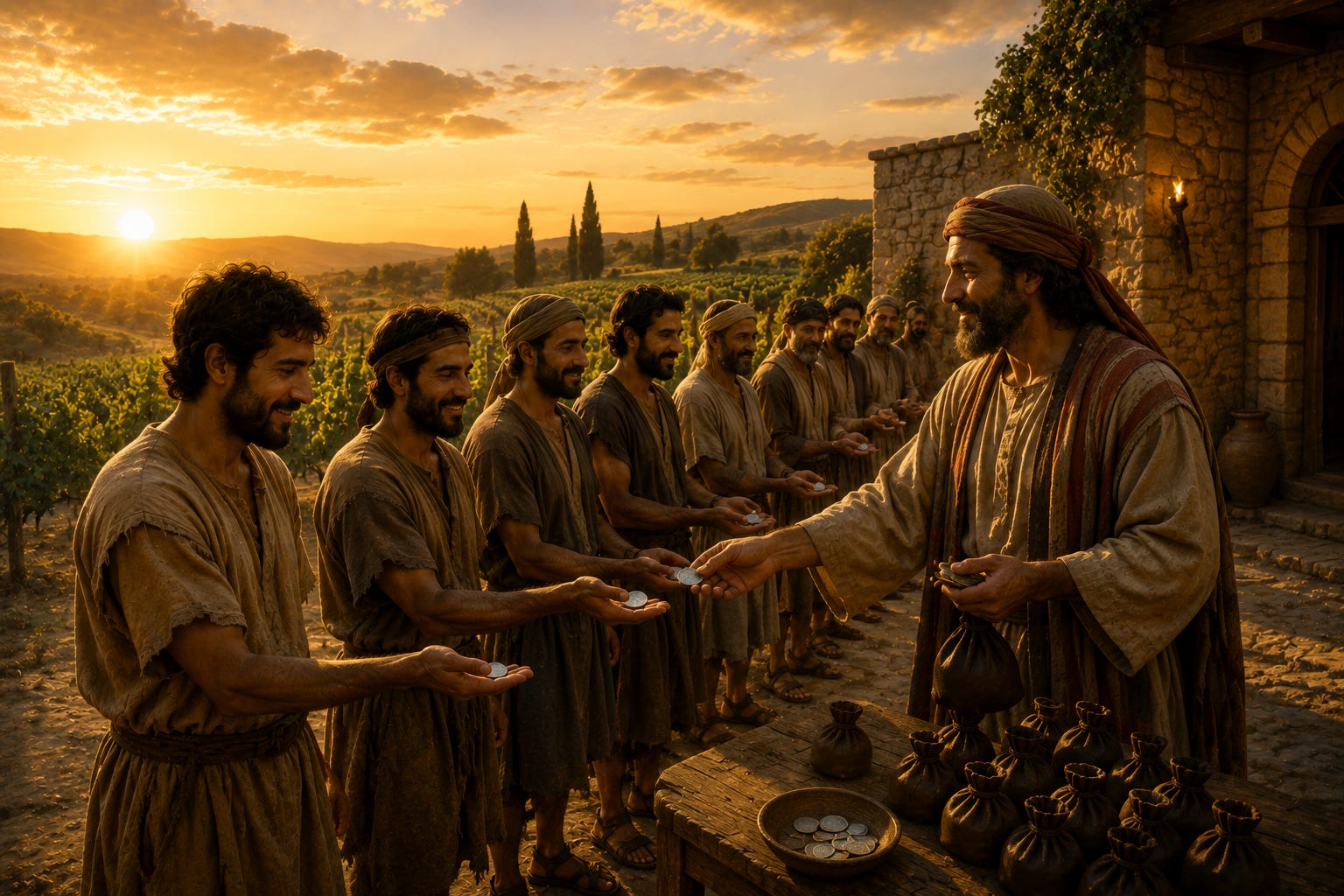
The men who had begun to work at five o’clock were paid a silver coin each. (v. 20:9)
those who worked only about an hour received a full day’s wage
So when the men who were the first to be hired came to be paid, they thought they would get more; but they too were given a silver coin each. (v. 20:10)
seeing this — those who worked all day assume they will receive more
instead — they received exactly what they originally agreed to receive
They took their money and started grumbling against the employer. These men who were hired last worked only one hour,’ they said, ‘while we put up with a whole day’s work in the hot sun — yet you paid them the same as you paid us!’ ‘Listen, friend,’ the owner answered one of them. ‘I have not cheated you. After all, you agreed to do a day’s work for one silver coin. Now take your pay and go home. I want to give this man who was hired last as much as I gave you. (v. 20:11-14)
the scandal of the parable is not injustice — because the landowner kept his agreement and paid all the workers one silver coin
the scandal begins with:
the unexpected generosity toward those workers who arrived late
the grumbling of the workers who worked all day in the heat — felt they were owed more
On Display:
grace is not earned by accumulating spiritual hours
grace is God’s free gift to give as He desires
(3) Comparison can make another person’s blessing feel like our injustice:
They took their money and started grumbling against the employer. (v. 20:11)
the first workers begin grumbling against the landowner
These men who were hired last worked only one hour,’ they said, ‘while we put up with a whole day’s work in the hot sun — yet you paid them the same as you paid us!’ (v. 20:12)
the workers’ complaint is rooted in comparison — the landowner made each workers’ time equal — regardless of the length of time each worker was hired
‘Listen, friend,’ the owner answered one of them. ‘I have not cheated you. After all, you agreed to do a day’s work for one silver coin. (v. 20:13)
the landowner reminds the workers that he has not cheated them
they each received precisely what they agreed upon
Don’t I have the right to do as I wish with my own money? Or are you jealous because I am generous?’” (v. 20:15)
the landowner exposes the deeper problem — are you envious because I am generous?
And Jesus concluded, “So those who are last will be first, and those who are first will be last.” (v. 20:16)
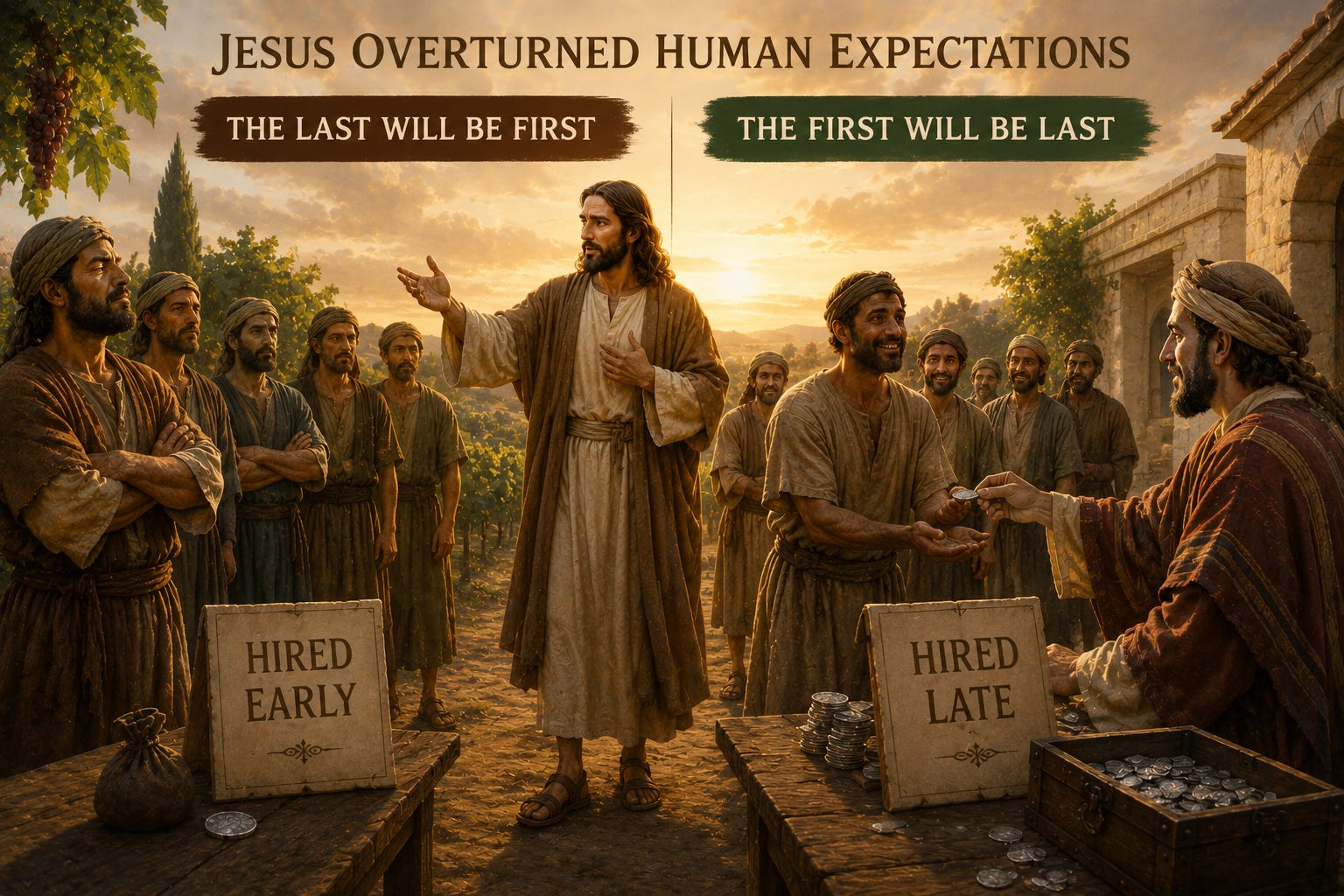
Jesus overturned human expectations
the last will be first
the first will be last
the first workers were satisfied with their wage until they saw what someone else received
this presents us with a sharp warning of God’s economy
(1) God’s Kingdom operates according to divine generosity rather than human comparison
(2) whether we enter the vineyard early or late — salvation remains a gift of grace rather than a wage we can demand
Fulfilling what was said:
(1) Theme: Israel was God’s vineyard:
Prophesy: (Isaiah 5:1-7) Let me sing for my loved one a love song for his vineyard. My loved one had a vineyard on a fertile hillside. He dug it, cleared away its stones, planted it with excellent vines, built a tower inside it, and dug out a wine vat in it. He expected it to grow good grapes— but it grew rotten grapes. So now, you who live in Jerusalem, you people of Judah, judge between me and my vineyard: What more was there to do for my vineyard that I haven’t done for it? When I expected it to grow good grapes, why did it grow rotten grapes? Now let me tell you what I’m doing to my vineyard. I’m removing its hedge, so it will be destroyed. I’m breaking down its walls, so it will be trampled. I’ll turn it into a ruin; it won’t be pruned or hoed, and thorns and thistles will grow up. I will command the clouds not to rain on it. The vineyard of the LORD of heavenly forces is the house of Israel, and the people of Judah are the plantings in which God delighted. God expected justice, but there was bloodshed; righteousness, but there was a cry of distress!
Fulfillment: Isaiah describes Israel as the vineyard of the Lord. Jesus takes this familiar prophetic imagery and uses the vineyard to reveal the character and Kingdom of God.
(2) Theme: God’s ways transcend human calculations:
Prophesy: (Isaiah 55:6-9) Seek the LORD when he can still be found; call him while he is yet near. Let the wicked abandon their ways and the sinful their schemes. Let them return to the LORD so that he may have mercy on them, to our God, because he is generous with forgiveness. My plans aren’t your plans, nor are your ways my ways, says the LORD. Just as the heavens are higher than the earth, so are my ways higher than your ways, and my plans than your plans.
Fulfillment: Isaiah declares that God’s thoughts and ways are higher than ours. The vineyard owner behaves in a way that overturns ordinary human expectations, revealing the surprising generosity of divine grace.
(3) Theme: God promises salvation to those who turn to Him:
Prophesy: (Isaiah 55:1-7) All of you who are thirsty, come to the water! Whoever has no money, come, buy food and eat! Without money, at no cost, buy wine and milk! Why spend money for what isn’t food, and your earnings for what doesn’t satisfy? Listen carefully to me and eat what is good; enjoy the richest of feasts. Listen and come to me; listen, and you will live. I will make an everlasting covenant with you, my faithful loyalty to David. Look, I made him a witness to the peoples, a prince and commander of peoples. Look, you will call a nation you don’t know, a nation you don’t know will run to you because of the LORD your God, the holy one of Israel, who has glorified you. Seek the LORD when he can still be found; call him while he is yet near. Let the wicked abandon their ways and the sinful their schemes. Let them return to the LORD so that he may have mercy on them, to our God, because he is generous with forgiveness.
Fulfillment: Isaiah invites the thirsty to come freely and urges the sinner to return to the Lord, “for he will abundantly pardon.” Christ fulfills this invitation by opening God’s Kingdom to sinners and calling people to Himself — even those who arrive late.
How can we apply what we learned — to how we live today?
we are reminded to stop measuring God’s goodness towards us and others
someone may come to Christ at age 15 and another at age 85
both will receive the save free gift of salvation
eternal life cannot be purchased
this difference does not make our lifelong faithfulness meaningless
working in God’s vineyard is itself a privilege
the danger comes when discipleship becomes a ledger in which we believe God owes us more because we have served Him longer
instead of asking:
Why did God give them that?
we learn to say:
Thank God they were invited into the vineyard too!
In short,
(Ezekiel 34:1-11)
Ezekiel delivers a devastating warning to leaders who have forgotten why they were given authority — the sheep do not exist for the shepherd — the shepherd exists for the sheep.
God sees the weak who were ignored, the wounded who were neglected and the people who wandered away because nobody went looking for them.
But…then one extraordinary promise was made — “I myself will search for my sheep.” Centuries later, Jesus would declare, “I am the Good Shepherd.”
(Matthew 20:1-16)
Jesus tells a story about workers who enter a vineyard at different hours but receive the same remarkable generosity from the landowner.
The problem begins when those who arrive first stop looking at what they received and start looking at what everyone else received. Comparison transforms gratitude into resentment.
Jesus reminds us that the Kingdom is not something we earn by keeping score — it is a gift flowing from the extraordinary generosity of God.